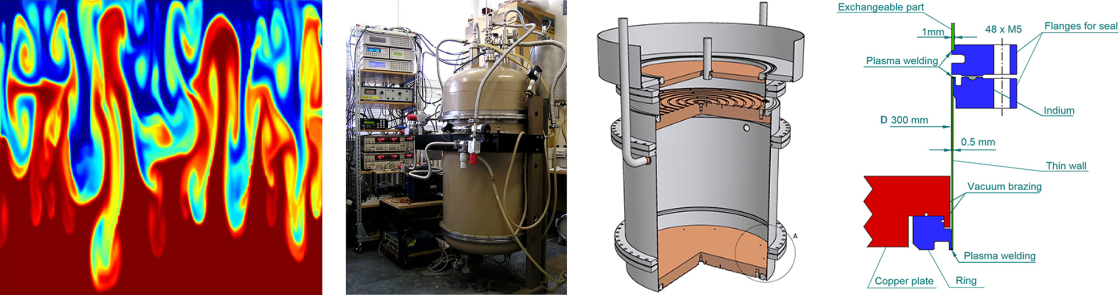
Our laboratory was the first one in Europe to visualize cryogenic flows of liquid helium. We employ the Particle tracking velocimetry technique (PTV), based on the tracking of the motion of micron-sized particles, dispersed in normal liquid or superfluid helium, and illuminated by a laser sheet. The motions of the particles within the flow is captured by a fast camera. Computer post-processing of the acquired images allows us to get access to time-resolved trajectories of individual particles, as well as other kinematic quantities (velocity, acceleration, etc.).
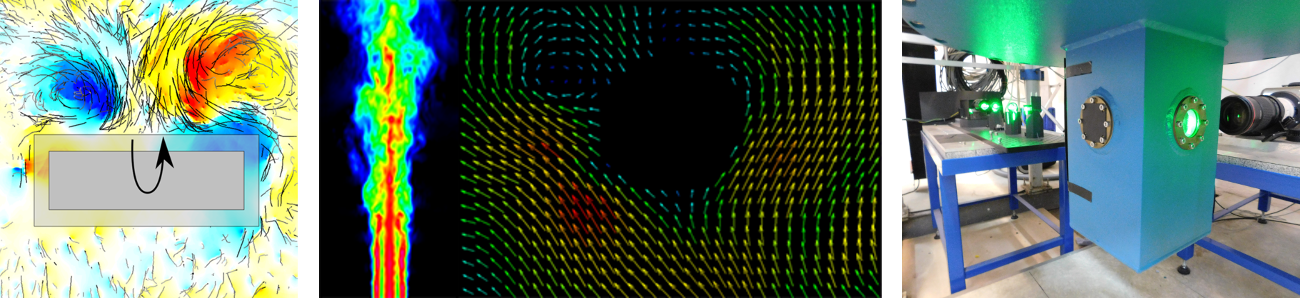
Second sound (i.e., temperature waves in superfluid helium), especially its attenuation in turbulent flows of superfluid helium, is widely used to directly measure the vortex line density, i.e., the total length of quantized vortex lines in unit volume. We observe both stationary turbulence, its temporal decay and more complex modulated flows in a series of different experimental channels and flow configurations (e.g., mechanically driven flows, thermal counterflow and pure superflow of the superfluid component of He II).
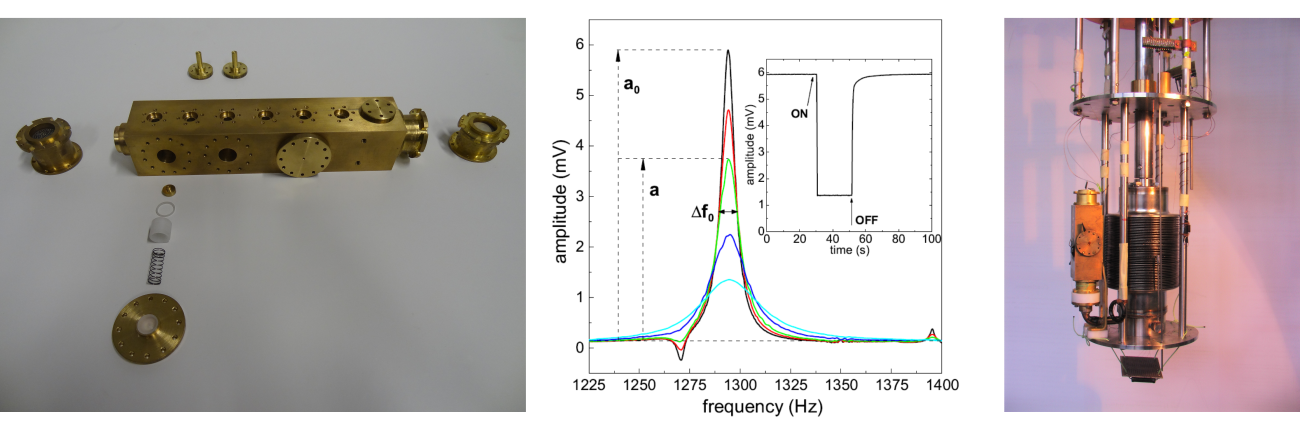
We employ various small oscillators to generate and probe laminar and turbulent flows in normal liquid and superfluid helium. We are mostly focused on the use of small quartz tuning forks and microwires, which allow direct measurements of relevant drag forces as a function of the flow velocity. Quartz tuning forks are manufactured commercially as frequency standards, having a typical resonance frequency in the order of tens of thousands of hertz. Electrical measurements of the fork velocity as a function of driving force, which can be transformed to a simple VA characteristic, allow us to probe critical velocities leading to the transition between the laminar and turbulent drag regimes in the flow, in both normal liquid and superfluid He.
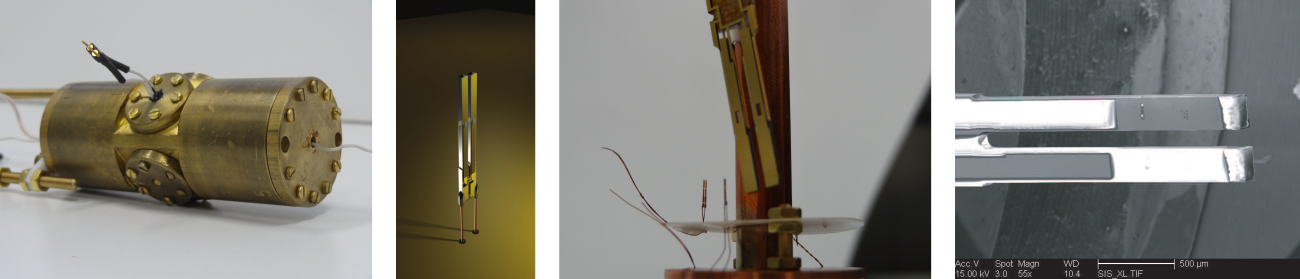
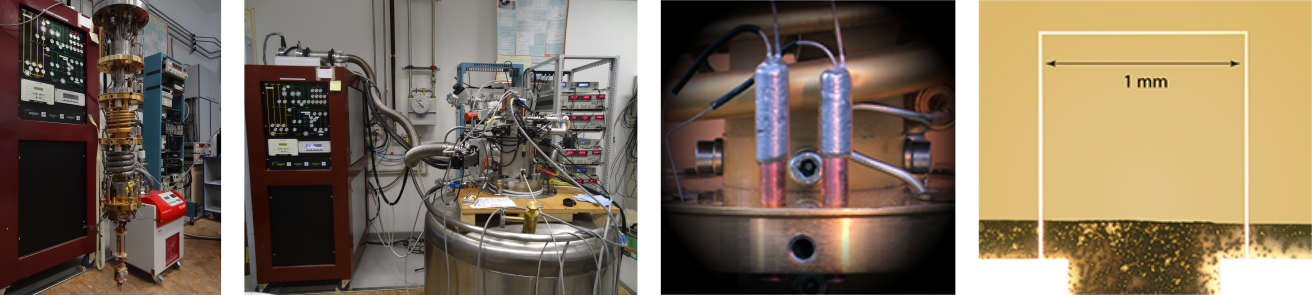
Since 2011, our laboratory is equiped with a powerful dilution refrigerator by Leiden Cryogenics. We can hence achieve temperatures lower than 10 mK, in magnetic fields up to 9 T, due to a superconducting solenoid. Two custom-made filling capillaries allow us to perform experiments in a pure superfluid, in the zero-temperature limit, in purpose-made experimental cells.
We perform experiments dedicated to the investigation of the onset of turbulence in the vicinity of mechanical oscillators, such as quartz tuning forks, microwires of a thin torsional disk filled with superfluid helium.
Convective heat transfer and two-phase convection is investigated in cooperation with the Institute of Scientific Instruments of the Czech Academy of Sciences in Brno. Effectivity of the heat transfer between a warm bottom plate and cool top plate of a purpose-made experimental cell filled with cryogenic helium gas ca be characterized by the Nusselt number Nu, up to the very large values of the Rayleigh number (Ra = 1015). The convection cell is designed by us and cooled by a bath of liquid helium.